
Torah opening and closing: Directions to avoid? (text and image descriptions below)
Looking further into the lev letters: That initial bet can be read as cautioning us away from some inquiries: Some say we are not meant to ask what is above, what is before, or what is below. The final lamed looks open both to what is behind us and to what is to yet come: The top embracing the relationship story just told; the bottom reaching around to new cycle, new insights.

Taking care not to turn our backs on the previous years’ struggles might be one message of that final lamed. But what else is the lev trying to tell us? What might it mean to fully explore the relationship building through Torah study? As comforting as it is to follow known, set patterns, when is the heart telling us we need something new?
Facing New Directions
What is ahead: Breishit, “At the beginning of God’s creating of the heavens and the earth,” starts with faces:
— now the Earth was Confusion and Chaos, with darkness on the face of Deep [v’hoshekh al-pnei t’hom]
and rushing-God-spirit [ruach elohim] moving on the face of the water [al-pnei ha-mayyim]

Genesis 1:1-2, slighted adapted Everett Fox (Schocken, 1995) translation
Focus quickly shifts from whatever is underneath those faces, as God undertakes the first divisions: Day from Night; Waters Above from Waters Below; dry land from Sea, with vegetation to fill the Earth; separation from day’s sun and night’s moon, serving as signs of set times. By the Fifth Day, when creatures of water and of air appear, those first faces have receded from the picture. Once humankind appears, followed quickly by Shabbat, the initial Chaos and Confusion seem quite distant….
But, by the time the Torah portion Breishit ends, God is already regretting the whole project. Although Jewish tradition encourages us to ignore some questions and plow ahead, something different might be required.
As with so many relationships, God and humanity seem stuck in patterns that continue to repeat if not examined. Maybe, participants in Tzedek Chicago Torah study recently suggested, it’s time we looked a different direction. Maybe we need to re-examine all those divisions that form the universe as we are taught to see it, reflect anew on the many boxes/categories our minds are trained to assume in this story and beyond. If we are going to imagine a new path forward, we have to shift our thinking somehow. And maybe that will require looking into that Chaos and Confusion.
With each new Torah cycle we have an opportunity to wrestle differently, to approach the relationship anew: Is there a mind-set you’d like to transform this year for yourself and/or the community? Is there unexplored relationship territory that could help us build in new directions? What more/different might we face in, and through, Torah this year?
NOTE: This post was edited slightly — for improved clarity, I hope — after initial posting on Nov 1.
Image Descriptions:
Torah opening and closing (IMAGE ONE)
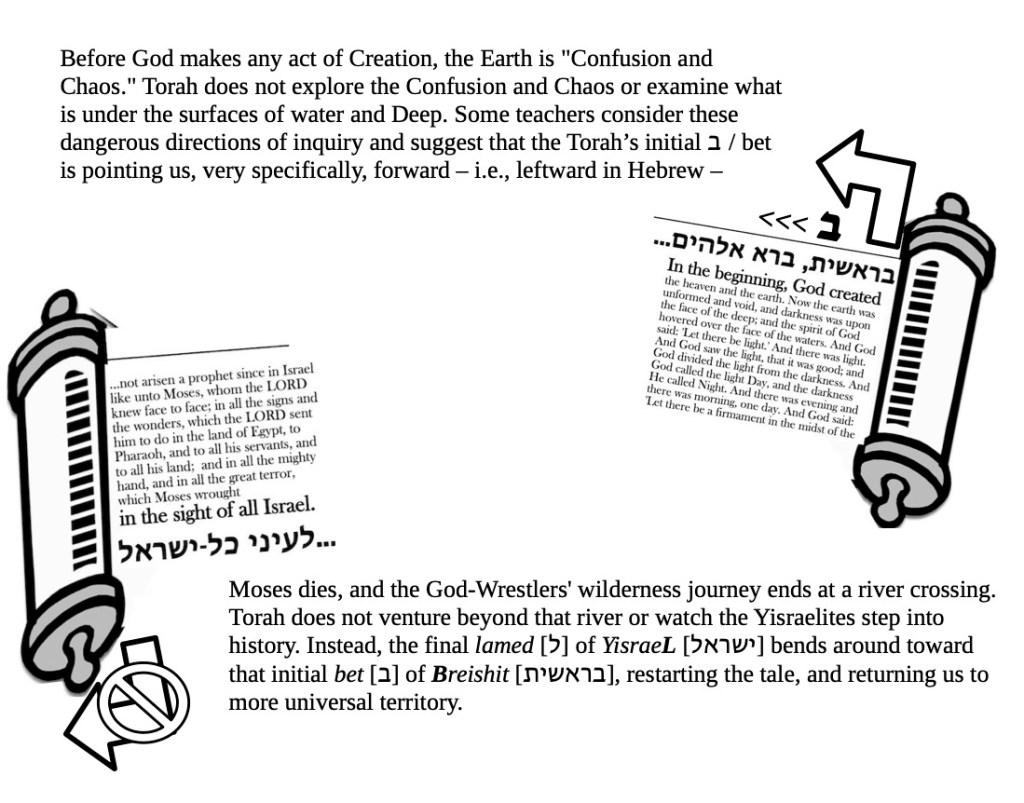
Before God makes any act of Creation, the Earth is “Confusion and Chaos.” Torah does not explore the Confusion and Chaos or examine what is under the surfaces of water and Deep. Some teachers consider these dangerous directions of inquiry and suggest that the Torah’s initial ב / bet is pointing us, very specifically, forward – i.e., leftward in Hebrew –
The text above is linked with an image showing a stylized Torah scroll open to “Breishit Bara Elohim… – – In the beginning God created…” and an arrow pointing leftward into the scroll’s story.
The text below is linked with an image showing a stylized Torah scroll open to the final words: “…l’einei kol Yisrael — …in the sight of all Israel” and a “prohibited” circle symbol on top of an arrow pointing beyond the end of the scroll.
Moses dies, and the God-Wrestlers’ wilderness journey ends at a river crossing. Torah does not venture beyond that river or watch the Yisraelites step into history. Instead, the final lamed [ל] of YisraeL [ישראל] bends around toward that initial bet [ב] of Breishit [בראשית], restarting the tale, and returning us to more universal territory.
Direction of study (IMAGE TWO)
Image shows large letter lamed, with a note pointing to the rightward focused top of the letter
“Top embracing the relationships developed and stories just told” note pointing to the leftward focused bottom of the letter…Bottom reaching to embrace a new telling, [with long arrow pointing back to a large bet, noting: ]“closed to what is above, closed to what is before; closed to what is below…open only to what is ahead”
 Rereading Torah Towards Liberation
Leave a comment